Tracing leaks without breaking open 8 methods explained
In the past, when there was a hidden leak, half a wall would be opened up to find the leak "somewhere". Now we first measure where the water is escaping, and only open up that spot. This is how the eight methods we use work.
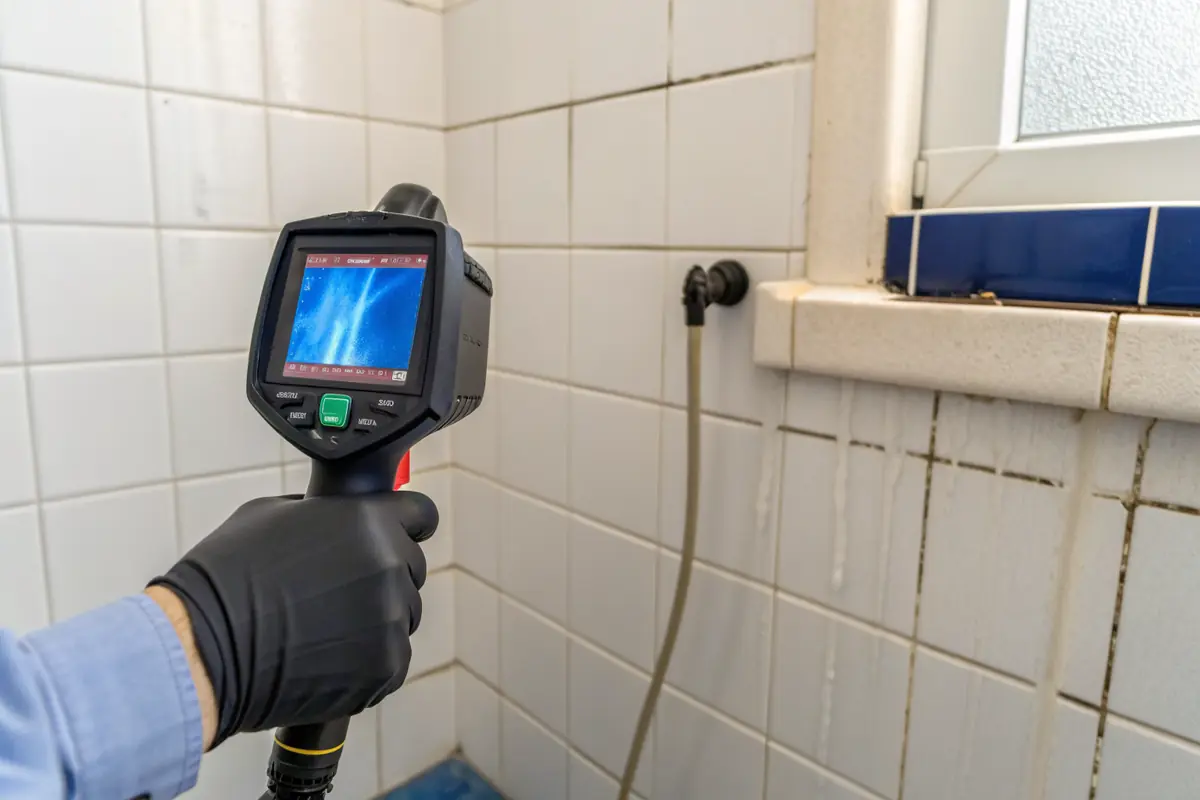
Which method we use depends on the type of pipe and where the water is moving. We often combine two or three: one method indicates the area, the other the exact spot. Only when the source is established is it opened in a targeted way and only where necessary.
Eight ways to find a leak
From thermal imaging to tracer gas.
Thermal imaging (thermography)
Temperature differences in wall or floor make the path of a hot or cold water leak visible, without touching anything. Effective for pipes in the screed and with underfloor heating.
Acoustic detection
Sensitive microphones hear the sound of water escaping under pressure from a pipe, even behind tiles and under the screed.
Moisture measurement
With a moisture meter we map the wettest point in materials. That wettest point usually points to the source.
Pressure and smoke test
For sewers and drains, we test pipes under pressure or with tracer smoke, so that a break or leaking joint becomes visible.
Camera inspection
An endoscope or drain camera inspects the inside of pipes and drains without breaking anything open.
Tracer gas
For deep or difficult leaks, a safe tracer gas (forming gas) flows through the pipe. A sensitive detector indicates above the floor where it is escaping.
Correlation measurement
Two sensors measure the leak sound on either side. From the difference in travel time we calculate the position of the leak: ideal for long, underground pipes.
Pipe locator
An electronic pipe and cable locator maps the route and depth of pipes, so we can measure precisely and never open up more than necessary.
What does it give you?
- Less damage: only open up where the leak actually is.
- Lower repair costs: no unnecessary replacement of tiles, floors or plastering.
- Certainty: you know what the cause is and what the best solution is.
- A findings report on request, useful for your insurer. Read what such a report contains.
How a leak detection survey works at your home
The methods above are tools. More important is the order in which they are used. A good investigation starts broad and becomes more precise step by step. This way measurements are not taken at random.
The steps
- Discussion and looking around. Where do you see damp, since when, and does it get worse with showering, heating or rain? Those answers already say a lot.
- Is it leak water or something else? Moisture can also come from condensation, a leaking roof or a damaged sealant joint. A moisture measurement and a look at the surroundings will make that clear.
- Which circuit is leaking? Using the water meter and the pressure of the central heating system, we can see whether the leak is in the cold water pipe, the hot water pipe, the central heating or the drain.
- Determine the area. Using thermal imaging, a pipe locator or moisture measurements, we narrow down the search area to a section of the floor or wall.
- The exact location. With acoustics, tracer gas or a camera we pinpoint the spot. Where possible, we confirm this with a second method.
- Mark and record. The location is marked and photographed. A report is provided on request.
- Targeted opening and repair. Only then is a small opening made to repair the leak.
Drains and sewers are different
A leak in a drain is not under pressure. That's why acoustic microphones usually don't pick it up. For drains and sewers, we more often work with a camera, a smoke test or a dye in the water. This way you can see on screen where a pipe is broken or a connection has come loose. You can read more about this on the sewer camera inspection page.
How to prepare for the visit
- Clear the area around the damp patch, the meter cupboard and the crawl space hatch.
- Note the water meter reading a day in advance and just before the visit.
- For underfloor heating or a boiler leak, do not turn off the heating unless we ask you to. Warm water actually helps with the thermal image.
- Keep photos of how the spot has developed.
That way the investigation is completed faster and the result is more reliable.
Good to know
Short answers to questions we're often asked.
No. We first locate the leak as accurately as possible. Only then is a targeted opening made, only where absolutely necessary.
There is no single best method: it depends on the pipe and the situation. We often combine several methods to be certain of the location.
Yes. We use forming gas, a mixture that is safe and evaporates quickly. It is only introduced into the pipe we are investigating.
Useful to know
More about leaks and leak detection.
Hidden leak? We'll track it down.
Without unnecessary breaking and demolition work, with a fixed price agreement in advance. Available 24/7 for emergencies.
Need immediate help? Our technicians in The Hague and surrounding areas can assist you with leak detection — call 070 783 0224.