Renovation plastering and ready for painting old walls smooth and paintable again
Renovation plastering and ready for painting? Call 070 783 0224 or send photos via WhatsApp.
Rated on Google · Price in advance · Guarantee on the work
On this page you can read what renovation plastering and ready for painting means, how we approach it and how the price is determined. We work in The Hague, Rotterdam, Leiden and the rest of Zuid-Holland.
Short answer
Renovation plastering is plastering on an existing, often old surface: wallpaper remnants, textured paint, loose plaster or cracks. The aim is usually ready for painting: a wall you can paint directly.
- Loose or hollow plaster must be removed first; otherwise the new layer will come loose with it.
- With old lime plaster we choose a material that adheres to it.
Call me back
Leave your name and number and we'll call you. Prefer immediate contact? Call 070 783 0224 or message us.
When to use renovation plastering?
In a property you've just bought, after years of wallpaper and paint, or after removing a kitchen or bathroom, walls are often full of patches, holes and transitions. With renovation plastering we turn them back into one smooth wall. The difference from ordinary plastering: first the old substrate must be assessed and repaired.
- Old property after purchase, before the floor goes in
- Walls with wallpaper remnants, textured paint or layers of latex
- After demolition work: transitions from old tiles, kitchen walls or removed walls
- Hollow or sandy plaster in pre-war houses
Strip off or plaster over?
That depends on what's on the wall:
- Well-adhering paint: roughen, apply bonding coat, plaster over.
- Textured paint or decorative plaster: often plaster over with a levelling coat; very coarse or loose = strip off.
- Hollow plaster: remove down to solid substrate, then rebuild.
- Wallpaper: always remove first.
Spray plaster, textured paint and decorative plaster from before 1994 may contain asbestos. If in doubt, have a sample tested before sanding, chiselling or demolishing. Plastering over an intact layer is often possible; we'll discuss this in advance.
How we tackle it
- Assessment: tap the wall, test adhesion, map cracks.
- Repair: loose parts removed, holes and chases filled, cracks reinforced.
- Level and plaster to the desired finish.
- Hand over with advice on priming and painting.
What does renovation plastering cost?
There is no fixed price for this job in our price list. You will receive a tailored quote based on photos and measurements, or after a brief on-site assessment. You will always know the price before we start.
- The condition of the old substrate
- How much needs to be stripped off or repaired
- The number of m²
- Ready for painting or ready for wallpapering
Plasterer in your municipality
We do this work throughout South Holland. For each municipality you can read more about the properties and the plastering work we encounter there:
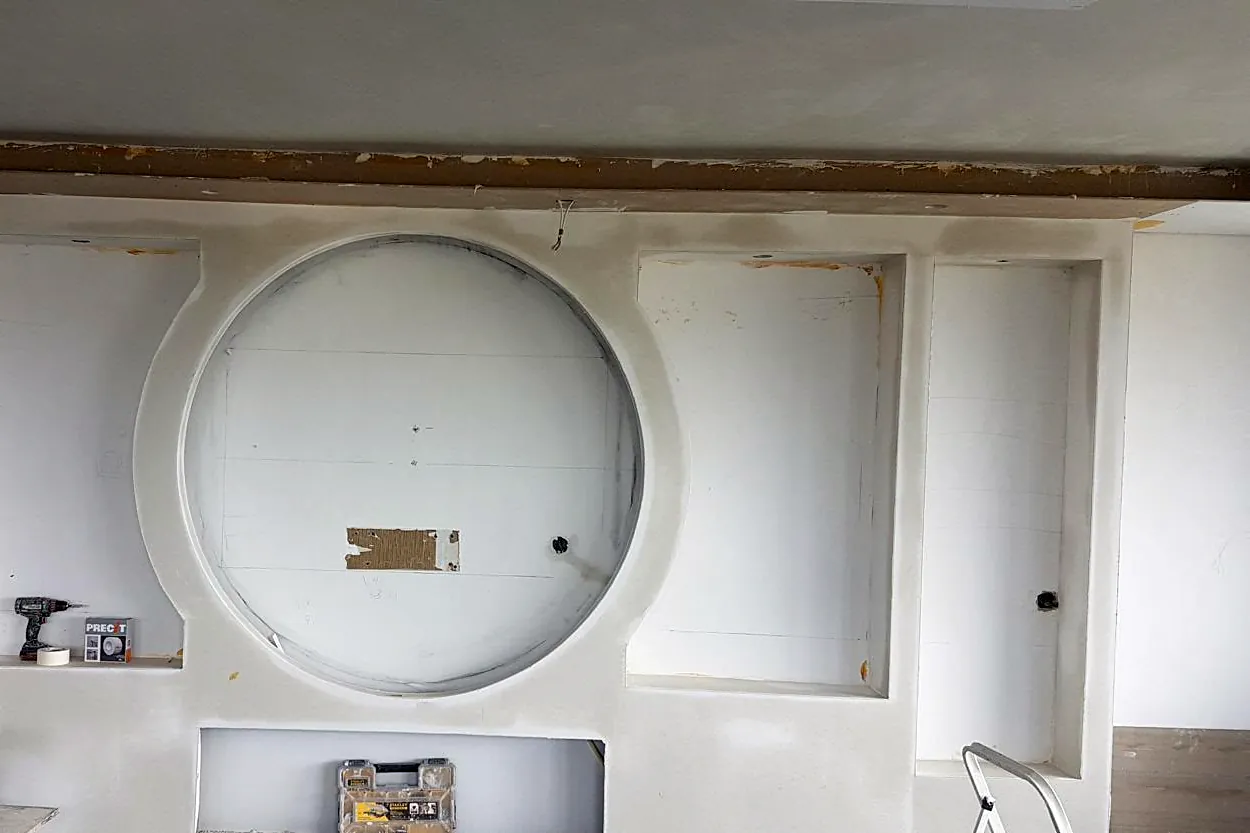
Joints and corners sharp
Questions about renovation plastering and ready for painting
Why is renovation plastering more expensive than new-build plastering?
Because the preparation takes more time: stripping, repairing and levelling before the actual plaster coat can be applied.
Can I remove the wallpaper myself to save money?
Yes, that saves work. Soak and scrape off the glue residue as well as possible. We'll do the rest.
My wall sounds hollow. Is that a problem?
Hollow plaster is no longer properly attached. A small spot can stay, but with new plastering over it we remove it, otherwise it can crack later.
How long before I can paint?
When the wall is completely dry: evenly light in colour. With a thin layer a few days, with thicker repair work longer.
How do I request it?
Call, send a WhatsApp message with a few photos and the measurements, or fill in the form on this page. You'll hear the price before we start.