Underfloor heating in The Hague from townhouse to apartment block
Planning underfloor heating or have a problem with your current system? Call 070 783 0224 or message us.
Rated on Google · Price in advance · Guarantee on the work
In The Hague, buildings of very different ages stand side by side: townhouses from around 1900, post-war apartment blocks and new builds in Ypenburg and Leidschenveen. Whether underfloor heating works well depends heavily on the house it's installed in. On this page you can read what we look for in homes in The Hague, which system suits which situation and what the municipality advises.
Short answer
In The Hague we almost always recommend wet underfloor heating, connected to the central heating boiler, a heat pump or later the district heating network. The municipality of The Hague also advises against electric underfloor heating as the main heating due to high running costs. In older properties we first look at the floor, the build-up height and the insulation, because the result depends on that.
- When renovating a ground-floor flat: watch out for build-up height and doors.
- Underfloor heating works best in a well-insulated home.
- Existing underfloor heating that won't heat up? See the faults page.
Call me back
Leave your name and number and we'll call you. Prefer immediate contact? Call 070 783 0224 or message us.
What the municipality advises
Wet over electric
In its guide to heating systems, The Hague municipality lists underfloor, wall and ceiling heating as examples of water-based systems, in which hot water carries the heat through the home. The municipality advises against electric underfloor heating, electric radiators and infrared panels as primary heating, because running costs are much higher. The municipality also recommends insulating the home first and then deciding on the heating system.
Source: The Hague municipality: heating system guide (pdf) (accessed October 2026). Rules may change; if in doubt, check the official source.
In addition, according to the municipality, The Hague must be off natural gas by 2050 at the latest. In busy neighbourhoods the municipality sees district heating as the best solution, and the municipality wants to establish a public heat company in 2026. That's good news for underfloor heating: wet underfloor heating can be connected to a central heating boiler, a heat pump or a district heating network. So you're not choosing one source forever.
Source: denhaag.nl: affordable district heating with public heat company (accessed October 2026). Rules may change; if in doubt, check the official source.
What we look out for in The Hague homes
- Townhouses and upstairs flats from around 1900 (Statenkwartier, Duinoord, Zeeheldenkwartier): wooden beam floors and often little insulation. Underfloor heating is possible, but requires a suitable build-up and usually insulation under or in the floor first.
- Walk-up flats and apartment blocks (Escamp, Laak, Mariahoeve): concrete floors with limited build-up height. A thin build-up or routed system can offer a solution. In an apartment, we also consult with the owners' association (VvE) when necessary for modifications to the installation.
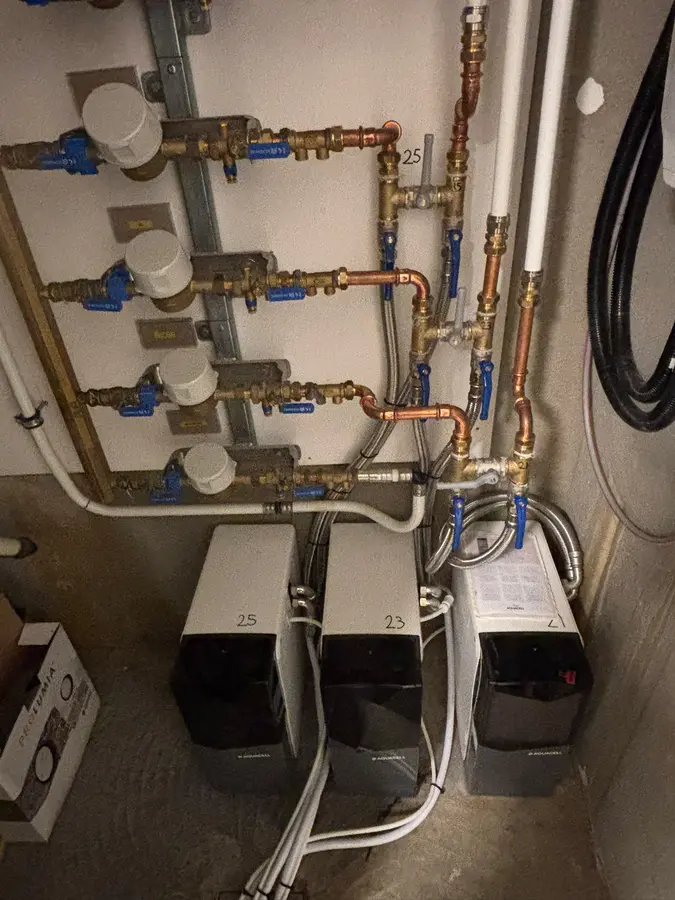
- New builds (Ypenburg, Leidschenveen, Wateringse Veld): often already have underfloor heating. There we mainly come for breakdowns, a manifold or extending to an extension.
- Bathrooms: underfloor heating in a bathroom is often included in a renovation. See also our bathroom renovation.
Which system suits your home?
Wet underfloor heating as main heating. Works with low water temperatures and therefore suits a heat pump or district heating well. Does require a well-insulated home and a floor that can accommodate the pipes.
Underfloor heating alongside radiators. Very common in Hague homes: underfloor heating in the living room or bathroom, radiators on the upper floors. There's then a mixing unit at the manifold that brings the water to the correct temperature.
Electric underfloor heating. Only for small spaces as supplementary heating, for example a bathroom floor. We advise against it as primary heating, as does the municipality.
Problems with your current underfloor heating?
How do you get a price?
There is no standard price for installing underfloor heating: surface area, floor build-up and connection determine the work. For breakdowns we work with our price list.
| Item | Excl. VAT | Incl. 21% VAT |
|---|---|---|
| Call-out charge for breakdown or on-site advice: first 30 minutes including diagnosis | € 100 – € 165 | € 121 – € 199,65 |
| Chiselling, breaking and milling work (per hour) | € 78 | € 94,38 |
| Installing underfloor heating per room | custom price after on-site assessment | you hear the price upfront |
Guide prices from the PandFix price list (October 2026). Call-out charge is additional: €35 excl. VAT (€42.35 incl.), emergency €65 excl. VAT (€78.65 incl.). Evening or weekend: surcharge €80 excl. VAT (€96.80 incl.). Materials and extra hours only by agreement. You will always hear the price before we start.
Questions about underfloor heating in The Hague
Can underfloor heating work in an old Hague townhouse?
Often yes, but it requires more preparation: a wooden floor, limited insulation and sometimes little build-up height. We first look on site at what's possible.
Is electric underfloor heating a good idea?
Not as main heating. The municipality of The Hague advises against it due to high running costs. For a small bathroom floor as supplementary heating it can work.
Can my underfloor heating be connected to a district heating network or heat pump later?
Wet underfloor heating can be connected to a central heating boiler, heat pump or district heating. That makes it a flexible choice now that The Hague is moving away from natural gas.
My underfloor heating in Ypenburg isn't getting warm. Will you come?
Yes. First check underfloor heating not getting warm for what you can check yourself, or call 070 783 0224.
What does underfloor heating installation cost?
That depends on the floor area and the floor type. After an on-site assessment you'll receive a tailored price.